Panzerkampfwagen Tiger Ausf. B or as most know it- King Tiger (also called Royal Tiger by some allied forces) was the "improved" version of the Tiger-and what a tank it was.... It came in production in 1943 and saw action from summer 44 and til the end of the war. Only 492 was built, and this was of course way to few to have a real impact on the outcome of the war. By summer 44 Germany had already lost all air-controle and was also weakend by supply shortage, low quality in production and not enough time to train crew.
The King Tiger "Königstiger" took the best from the Tiger and the successfull Panther and combined them into an even bigger and better tank. The armour and armament was still bigger and better than any allied tank, and the successfull curves on the Panther was used to some degree on the King Tiger, making it harder to destroy with tank/anti-tank shells. It had two types of turret- the early "Porsche" turret wich was very sloped, and the Henschel-turret. Henschel&Son/Krupp was the producer/manufactorer of the tank, and we should all be glad this tank didnt come int production until late in the war-the kill/death ratio of the King Tiger agains enemy tanks was impressive, even with severe challenges on all fronts from production, training and supplies. For example, the 103d SS Heavy Panzer Battalion in the period january-april 1945 on the eastern front had about 500 kills with their King Tiger tanks, with a loss of only 45, most destroyd by own crew to avoid the enemy capturing them after they had had damage/mechanical problems.
Numbers: Weight: 69 tons Length: 7.38 metres Width: 3.75 metres Height: 3.09 metres Armour: up to 180 mm of steel.... Armament: 88 mmKwk Speed: 41 km/h (road)
Surviving Units:
There are several King Tigers in museums today, in all of the big countries winning the war- Russia, France, USA and England to name some-there is also on i Germany, in Deutches Panzermuseum in Munster. The only operational is in France in Musee des Blindes.
A King Tiger in Budapest 1944 part of 503d Heavy Panzer Battalion
King Tigers lined up for German Newsreel footage
King Tiger in Budapest, I like the way this photo shows how massive the gun really is...
Photo: Rommel and some of his men in the Battle of France
Fast as the wind
The Invasion has begun
Shaking the ground
With a force of 1000 guns
First in the line of fire
First into hostile land
Tanks leading the way
Leading the way
(From the song "Ghost Division by Sabaton)
7.th Panzer led by the famous Erwin "Desert fox" Rommel got the nickname "Ghost Division" in 1940 in the France campaign. They were given the nickname because they advanced so fast that they appeared were they werent expected, and even German high command didnt always knew were they where.
The beginning:
7.panzer corps took part in the campaign in Poland, and was after that strengtened and became a full panzer division. Erwin Rommel was asked b y Hitler which command he wanted for the battle of france, and Rommel-having no tank experience choose a panzer division, and 15.february 1940 he was given command of the 7.th Panzer division which was part of the 15.Panzer Corps under General Hoth.
Ghost Division in France:
Erwin Rommel lead his division from the front, often from the top of a tank, earning him great respect from his men. This also aloud him to make decisions much faster then commanders who stayed behind the frontline. His results and his relationship to Hitler made him immune to the critism from the High Command who sometimes ment he was to independent in his decisions.
Timeline for Ghost Division in France:
10 May 1940 - Fall Gelb, the invasion of France, is launched. 7th Panzer advances through the Ardennes. 12 May 1940 - 7th Panzer Division reaches Dinant on the Meuse. 13 May 1940 - Crosses River Meuse after heavy fighting. 15 May 1940 - Reaches Philippeville and continues Westward passing Avesnes and Le Cateau. 21 May 1940 - Reaches Arras where counterattacked by 2 British Tank Regiments. British tank advance stopped by feared Flak 88 "Tank Killers". 5 June 1940 - Positioned near Abbeville. 8 June 1940 - Reaches outskirts of Rouen. 10 June 1940 - Reaches English Channel West of Dieppe. 17 June 1940 - Reaches Southern outskirts of Cherbourg. 19 June 1940 - Garrison of Cherbourg surrenders to Rommel. 25 June 1940 - Fighting ends for 7th Panzer Division in France.
7.th Panzer Division since 10th May had captured: The Admiral of French Navy (North) and 4 other admirals, 1 Corp Commander, 4 Divisional commanders with their staffs, 277 artillery and 64 anti-tank guns, 458 trucks and armored cars, 1,500-2,000 cars, 1,500-2,000 horse- and mule-drawn wagons, 300-400 buses, and 300-400 motorcycles.
About 30 000 prisoners of war were captured Apart from this it had brought down 52 aircraft, captured 15 more on the ground, and destroyed another 12. There was much more booty which could not be counted because the division moved too fast.
Its own casualties during the period were: 48 officers killed and 77 wounded; 108 sergeants and above killed and 317 wounded; 526 other ranks killed and 1252 wounded. While missing included 3 officers, 34 sergeants and above and 229 other ranks
Ghost Divison after France:
From 1941 the Ghost Division-7.th Panzer was mainly in action in Russia, being one of the forced bthat came closest to Moscow. In the end, they surrendered to british troops in Germany.
7.th panzer on their way through the french countryside-possibly near Somme
Erwin Rommel in France 1940
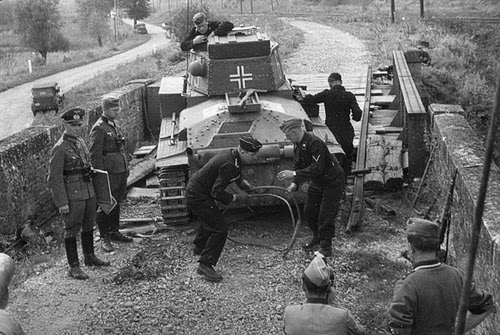
Erwin Rommel and a Pz38t tank on a bridge passing in France 1940
The song "Ghost Division by Sabaton and a fan-made video
Panzerfaust was a german anti-tank weapon for infantry, its was cheap, had a single shot and was recoilless. It consisted of a small, disposable preloaded launch tube firing a explosivr anti-tank warhead, and was operated by a single soldier. They had a range from 30m (Panzerfaust klein) up to 150m for the Panzerfaust 150.
The Panzerfaust was used in great numbers from 1942, but we often think of the last defence of Berlin when we see it. I must admit it breaks my heart to see women and young boys holding a close combat anti-tank weapon because one maniac deep under ground wouldnt surrender...
These are the versions of the Panzerfaust that was produced and used in WW2in some numbers, Panzerfaust 150 barely saw any action as it was put into production only two months before the war ended.
Its quite brilliant with its simlicity actually...
Doesnt this break your heart? Hitlerjugend member shown how to use the Panzerfaust...
The Landkreuzer 1000 "Ratte" (Rat) was another one of Hitlers "I get madder-tanks get bigger" strategy as an answer to the heavy russian tanks the germans encountered on the eastern front. We have already seen how this led to the quite succesfull(at least performance wise) Tiger and the absurdly Maus but the madness didnt stop there, at least not on the drawing board. In 1942 Krupp (yes-they did make money of everything that needed steel!) suggested an even bigger tank. Or lets be honest-this is a warship on land!
Numbers: Weight: 1000 tons Length: 35 metres Width: 14 metres Height: 11 metres Armour: up to 250mm of steel.... Armament: 2*280mm canons (yes-the same as the triple 28cm on light german battleships...) Crew: 20-40 Speed: 40km/h (I think this is optimistic...)
There was also plans for two compartments with a BMW motorcykle for scouting.
Albert Speer stoppet the project i 1943, probably seeing the madness in it all, before a prototype was constructed. Seeing these drawings of its size, I can understand why-this thing would have been impossible to use in mobile warfare, its as easy as that, and its a hell of an expencive gun turret....
Theres some debate as to what the secondary armament would have been, suggestions are either flak-guns or 50-128mm anti-tank guns.
Its so big its beyond funny...
One suggestion on what it might have looked like
Heres another suggestion to what it might have looked like
The Tiger Tank as it is most known as, or in the usual light german language "Panzerkampfwagen VI Tiger Ausf.E" , is one of the most known tanks from WW2-if not the best known. The reason of course is that it was an absolutely masterpiece of engineering, and head to head swept all other tanks away from the moment it began hitting the battlefields of Europa in 1942. Brief background history:
The Tiger was the german response to russian tanks-especially the great T-34- giving up a much better fight than expected in the inasion of Russia fra 22.june 1941. The germans soon realised they needed a bigger tank. Actually they needed a bigger gun-but to hold a bigger gun-you need a bigger tank-and the Tiger was the answer. The best gun against the russian big tanks was the 88gun, wich was actually a flak gun but proved for a fantastic anti-panzer gun as well. The Tiger was the first tank equipped with the 88mm gun. Production began in 1942 and ended in 1944, when it was faded out for the Tiger 2-or the King Tiger as most call it. (more on that beast in another article!) Fun fact: The Bovington Tank Museum has a running Tiger tank, the only one in the world! The tank numbered 131 was captured in Tunisia in 1943. See video and the bottom of this article
Fun fact 2: Because of its weight naturally the Tigerhad problems with
sinking into...well-mostly everything. The recomended test for the crew
was this: TAke one of the other crewmembers on your back and stand on
one fot. If your fot sinks in, so will the Tiger Numbers:
Weight:56.9 tons
Length:6.3 metres
Width:3.7 metres
height: 3.0 metres
Main armament: 88mm
Secondary armamaent: 2*7.92 MG
Speed: 38km/h
Armour: Up til 120mm at the turret, 100mm in the front-this was strong enough to resist a direct hit frem the american Sherman tanks 75mm guns, its main opponent at the western front. About 1300 Tigers were produced from 1942 til 1944.
Problems:
Even a Tiger have problems- for the Tiger tank this was mainly related to the fact that it was timeconsuming and expencive to produce. While russian factories were pouring out T-34`s many of the Tigerparts had to be handmade, it also used a lot of fuel (which became a big issue for Germany as the war starting going poorly) and there was also some problems with traction and transportation. Despite this problems, the Tiger was the most feared sight on the battlefields in 1942-1944, a fully working Tiger tank was almost impossible to destroy for enemy tanks, and it kill-.death ratio on the battlefield was legendary. In the largest tank battle in history-the battle of Kursk in russia, the Tigers fell as often to mechanical problems as they did to enemy fire.
Tiger Ace:
Michael Wittman is the most famous tank commander from the Tigers, involved in panzer battles from the invasion of Poland (not in a Tiger then of course) and until 1944 when he was killed in France. He is most known from the Battle of Villers-Bocage, when he from a Tiger tank destroyd 14 enemy tanks, 15 personel carriers and 2 anti-tank guns. In 15 minutes-with a little help of course.... This is how this column of british vehicles looked after Wittmann had a go at them from a single Tiger...
Tiger assembly line
Tiger destroying a russian tank at the battle of Kursk
A Tiger battalion has the right of way. Always.
Tiger tanks in russia 1943 (Probably the Grossdeutschland division)
Panzerkampfwagen VIII Maus is the heaviest tank ever built, and was a part of the "the mader I get the bigger it gets" tactics Hitler used, especially in the later parts of the war. Ferdinand Porsche, most known for considerably smaller vehicles was the architect behind the MAUS. People who say germans dont have a sense of humor-calling this tank "MAUS" (Mouse) proves you wrong. This is a beast even compared to the other super-tanks from WW2, and reminds me more of a small warship than a moveable object on land. But it did move. Slowly,deeply and litte-but it did move. Lets get some basic facts out of the way so we can get to the good stuff-the photos!
Weight: 188 tons (jupp.Tons. About the same as 6 US Sherman tanks....) Length: 10.2 metres Width:3.71 metres Height:3.63 metres Main gun: 128mm Secondary gun: 75mm Speed: 13-19km/h some diagreement on this
Fun fact : Because of its enormeous weight, the MAUS couldnt use bridges. It was therefore equipped with a snorkel, and had to be connected to another MAUS for power to the electrodieselengines while crossing rivers. Yup-crossing as in going under water. I said it reminded me of a warship...
Did it see combat one might wonder?
No it didnt-only 2 were ever produced and they were blown up by own crew when the area around the factory was overrun. There is in fact one remaining today, in a museum in Russia-more on this with the photos:
Early drawing
Size does matter...
I mean really...just look at that thing!
Size does have it challenges...like sinking...
Grab a shovel were almost there...
This turret from the V2 (Second version built) was put on the V1 hull




.jpg)


